The Environmental and Economic Impact of Recycling: 9 Key Advantages
The three Rs—reduce, reuse, and recycle—must be strictly followed by everyone, including in the home, business, and industrial sectors, in order to help conserve the planet’s limited resources and lessen waste and pollution.
The environmental and economic benefits of recycling are therefore more important than ever. How can recycling benefit the environment? The environmental advantages are discussed in this article, including preserving Earth’s limited resources and reducing the effects of hazardous landfills, the quantity of plastic that is dumped into the oceans, and the levels of pollution in the world.
So why is recycling important? Not only does it mitigate the need for new raw materials and reduce the amount of waste, recycling has a positive social and economic impact on people and businesses, which is also covered in this article.
Environmental Benefits of Recycling
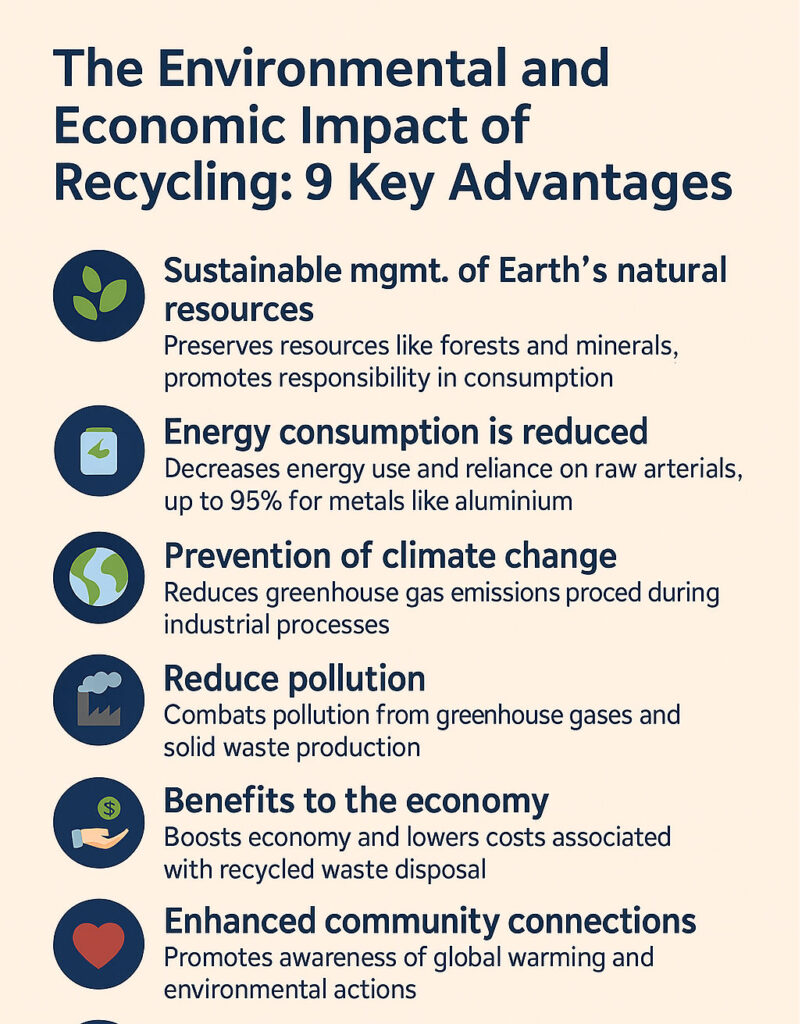
Sustainable management of the Earth’s natural resources
We must first acknowledge that the Earth’s natural resources are limited before we can discuss the objectives and advantages of recycling. To put it another way, the more we recycle, the more we can preserve natural resources and encourage both individual and corporate responsible consumption.
For instance, deforestation damages a great deal of our natural resources, including woodland ecosystems and virgin rainforests. Recycling paper and cardboard products lessens the need for deforestation helping to preserve rather than destroy the ecosystems that regulate our air quality and weather systems.
As metals such as iron, copper, and aluminium can all be recycled, less natural resources need to be mined, thereby reducing the need for extraction and preserving the natural supplies of these minerals.
Energy consumption is reduced
Another reason recycling is so important is to reduce energy consumption and conserve natural resources. For instance, it takes 95% less energy to recycle tin cans into new aluminium items than it does to make the same out of raw materials. This ensures that the energy we use is more environmentally and economically sustainable while also cutting the use of raw materials.
The production of paper and plastic products is also subject to the same energy-saving regulations. Using recycled materials can help businesses cut their energy use by up to 30% overall. In short, reusing materials saves energy and has a lesser environmental impact.
Prevention of climate change
Climate change is also caused by greenhouse gases like carbon dioxide (CO2). Research shows that using fossil fuels to produce energy traps heat and causes global warming, highlighting the urgent need for environmental protection. Fossil fuels, which emit greenhouse gases into the atmosphere, are usually used to generate the energy required for the majority of industrial activities.
Recycling has the advantage of lowering greenhouse gas emissions since it uses less energy to turn raw materials into products that may be sold and manufactured, contributing to the economic benefits of recycling. Recycling can help us use fewer fossil fuels, which will lessen the amount of toxic gases released into the atmosphere and their negative impact on the environment.
Benefits to the economy
Recycling has other benefits, such as the fact that many initiatives encourage businesses and individuals to collect recyclables, including plastic, glass, bottles, and cans. It has been proven by experts that disposing of recycled waste is substantially less expensive.

Businesses in the hospitality sector, for instance, can spend money on organic recycling. Under this method, waste is not just disposed of in bins; it can also be transformed into valuable and useable compost, sometimes by using large food waste bins. In addition to lowering waste disposal expenses, this has a hugely favourable environmental impact. By fertilising plants with this compost, organic composting helps to preserve the soil’s natural fertility.
Reduce pollution
Recycling fights pollution from greenhouse gases and solid waste in two ways. Studies show that recycling materials like cardboard, for instance, greatly lowers CO2 emissions and production.
Recycling materials reduces the quantity of waste generated during manufacturing in addition to CO2. Solid waste releases methane during anaerobic decomposition, which is 21 times more warming-potent than CO2, making it much more harmful to the environment.
Recycling also reduces the pollution that comes from the procurement and repurposing of virgin resources. Water and soil can become contaminated by toxic substances used in mining operations. Polluted water is a waste product of the refinement of basic resources. Mining is less necessary when materials are recycled, which lowers the amount of pollution and hazardous pollutants produced.
Enhanced community connections
Recycling is something everyone can do. Every single item that is recycled can help reduce the impact on the environment and have a beneficial impact on the community, whether it is a small-scale effort at home or a notable campaign within a big business.
Enhanced community connections are one benefit of recycling. We are also encouraged by governmental entities to educate ourselves on the effects of global warming and the actions we may take at home, at work, and in school. Recycling bins, for instance, can be placed in public areas to relay a visible and good message to the larger community.
Reduced landfill waste
Environmentalists believe there is no such thing as a safe or environmentally responsible landfill. When it comes to landfill runoff and waste, many people push for zero waste schemes in addition to net-zero emissions.
Recycling reduces waste going to landfills. Instead of taking years to decompose, emitting pollutants and emissions, and taking up space that could be better used, recycling decreases landfill waste and has a positive influence on the environment.
Composting at home, for example, is one method we can use to reduce landfill waste. Food waste can be turned into a home-made fertiliser that can be used for plants growing on windowsills, gardens, and allotments.
The creation of jobs
When answering the question, “What are the benefits of recycling?” it is important to take into consideration the creation of jobs. There is an overwhelming agreement among experts that companies need to change their focus from traditional jobs to green ones, which include roles in recycling and environmental protection.
Recycling has numerous advantages, one of which is that it generates a large number of chances for “green jobs,” many of which are currently being provided by the recycling industry. In addition to outreach and education, green career paths might include positions that are centred on technology and manual labour. In addition to environmental benefits, the recycling industry has also resulted in the creation of a wide variety of new jobs.
Technology and innovative ideas
Recycling efforts have been improved as a result of technical advancements such as waste management solutions that are enabled by the Internet of Things (IoT) and waste valorisation systems. These advancements are working to remedy the imbalances that are caused by climate change. As an example, intelligent systems such as smart bins are able to identify and categorise various types of waste, which makes recycling much easier. Additionally, infrared sensors that are powered by artificial intelligence are able to sort and classify plastics, which results in more effective recycling.
Technology has been developed specifically for the purpose of designing new and simpler methods of recycling. Scientists have even utilised nanotechnology to improve existing materials and make them more suitable for recycling. One example of this is the process of pyrolysis, which converts plastic into fuel. This helps reduce the amount of plastic waste that is produced.
Conclusion – Advantages of Recycling
Whether it is recycling glass, metals, paper or plastics, recycling has more advantages than disadvantages when the pros and cons are considered. Choosing to recycle materials helps to minimise greenhouse gas emissions and hazardous waste by reducing energy consumption and manufacturing costs for new products.
Through promoting eco-friendly habits, generating new technology developments, and creating new green jobs, it also contributes to the strengthening of a sense of community in general.
Your primary strategic partner for any recycling project is Jettison Express. Providing efficient recycling of paper, garbage, and technology is one of our primary goals. Explore Jettison Express’s services, including:
- General Waste Recycling: In order to reduce landfill usage and increase recycling rates, Jettison Express makes sure all waste collected from residential and business clearances is properly sorted and recycled.
- WEEE (Waste Electrical and Electronic Equipment) Recycling: For the disposal of electronic waste, such as PCs, monitors, and other IT equipment, we offer specialised services. This covers safe data deletion and ecologically friendly recycling methods.
- Donation of Reusable Items: In order to encourage recycling and help those in need, well-maintained items like clothing, appliances, and furniture are donated to local charities and community organisations.
- Garden Waste Recycling: When it comes to the disposal and recycling of garden waste, Jettison Express makes sure that organic materials are handled in an environmentally responsible way.
After identifying and assessing your company’s recycling needs, there are numerous advantages to putting recycling programs into place. Offering multi-tiered recycling solutions and other solutions to support and accelerate your go-green goal and assist you in lowering your carbon footprint, Jettison Express is a carbon neutral company that places a high focus on environmental commitment.