 Decluttering
 Room Organisation
 Storage Solutions
 Small Spaces
 Cleaning & Home Routines
 Product Guides
How Do You Declutter When Your Partner Will Not Let Go of Anything?
Why some people find letting go so hard, how to talk about it without a row, and compromises that work for both of you.

Quick answer: Start with your own things, not theirs. Talk about how the clutter affects daily life rather than criticising their belongings, agree shared spaces and personal spaces, and give each of you full say over your own possessions. Use clear, fair limits, such as a set amount of shelf space for a collection, and make shared decisions together. If it causes real conflict or distress, a neutral professional can help.
In this article
Living with someone who keeps everything when you would rather live with less is one of the most common sources of household tension. You might want clear surfaces and a calm home, while your partner sees value and memories in every magazine, cable and spare part. Neither of you is wrong, but the home has to work for both. This guide explains how to approach decluttering together without damaging your relationship.
Why some people find it so hard to let go
Understanding why your partner holds on makes the conversation easier. Common reasons include:
- Memories. Objects connect people to their past, their family and important moments.
- Usefulness. "It might come in handy one day" is a powerful feeling, especially for people raised to waste nothing.
- Money. Getting rid of something that cost a lot can feel like admitting it was wasted.
- Identity. Collections, books and hobby equipment can be part of how someone sees themselves.
- Control. Feeling pushed to get rid of things can make people dig in.
- Anxiety. For some people, letting go of things causes real distress.
If your partner's difficulty letting go seems extreme, causes them great distress or makes the home unsafe, it may be worth gently encouraging them to talk to their GP, as hoarding can be linked to mental health.
Start with your own things
The most effective first step is also the simplest: declutter your own belongings first. It shows what a calmer space looks like, it demonstrates that you are not asking anything you would not do yourself, and it often inspires the other person without a word being said. Our guide to how long it takes to declutter a house can help you plan.
How to talk about it
- Pick a calm moment, not when you are both tired or in the middle of a row.
- Talk about the effect, not the stuff. "I find it hard to relax when the table is covered" works better than "your junk is everywhere".
- Ask what matters to them. Find out which things they really care about and why.
- Agree a shared goal, such as being able to have friends round or use the spare room as a bedroom.
- Listen more than you talk.
Compromises that work
Personal spaces and shared spaces
Agree that each of you has an area that is entirely yours, such as a room, a corner or a cupboard, where the other person has no say. Shared spaces such as the kitchen, living room and hall follow rules you both agree.
Container limits
Rather than arguing over individual items, agree how much space a category gets: one shelf of magazines, two boxes of cables, one bookcase. Your partner chooses what goes in the space. When it is full, something has to go before anything new comes in.
A maybe box
Items your partner is unsure about go into a dated box. If nothing has been taken out after six months, the contents are donated without reopening the box.
One in, one out
For things that keep building up, such as clothes, mugs or gadgets, agree that something leaves for every new item.
Sort together
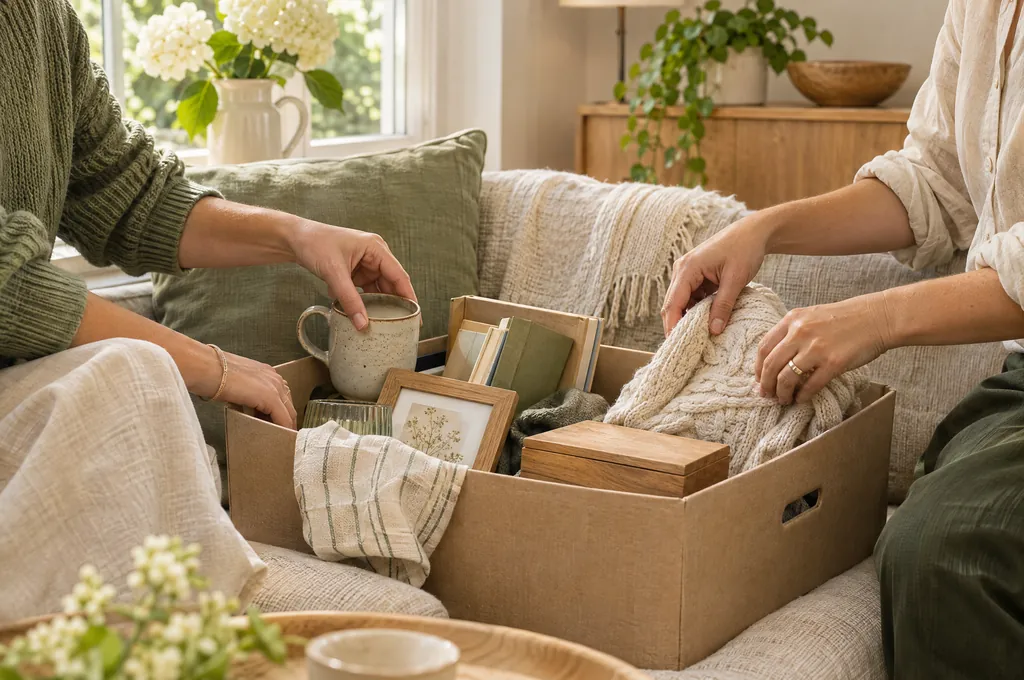
Set aside short sessions to go through one box or one cupboard together. Make it pleasant, with a cup of tea and a time limit, and let your partner make the final call on their own things.
What not to do
- Never throw away your partner's things without asking. It destroys trust and usually makes them hold on more tightly.
- Avoid sarcasm, labels and comparisons with other people's homes.
- Do not try to do everything at once.
- Do not make it a battle you have to win.
Romaine's tip: Celebrate every success together, however small. A cleared table, an emptied box or a room you can use again is a shared win. People are far more willing to keep going when progress feels good rather than forced.
When outside help makes sense
Sometimes a neutral third person can do what a partner cannot. A professional organiser has no emotional stake in your belongings, can help you both make decisions, and can suggest storage and systems that work for different styles. See the difference between a professional organiser and a cleaner and our personal organising service. If the person finding it hard is an older parent, our guide to helping elderly parents declutter may also help.
Frequently asked questions
How do I get my partner to declutter?
Start with your own belongings, talk about how the clutter affects you both, and agree fair limits and personal spaces. Pressure rarely works.
Should I throw my partner's things away?
No. Throwing things away without permission damages trust and usually makes the problem worse.
What if my partner is a hoarder?
If keeping things causes them real distress, takes over the home or makes it unsafe, gently encourage them to talk to their GP, and consider specialist support.
Can a professional organiser help couples?
Yes. A neutral organiser can help both people make decisions and find compromises that suit different styles.