 Decluttering
 Room Organisation
 Storage Solutions
 Small Spaces
 Cleaning & Home Routines
 Product Guides
What Should You Do With Old VHS Tapes in the UK?
Why home videos should be digitised before they go, what it costs, and how to dispose of tapes and players properly.
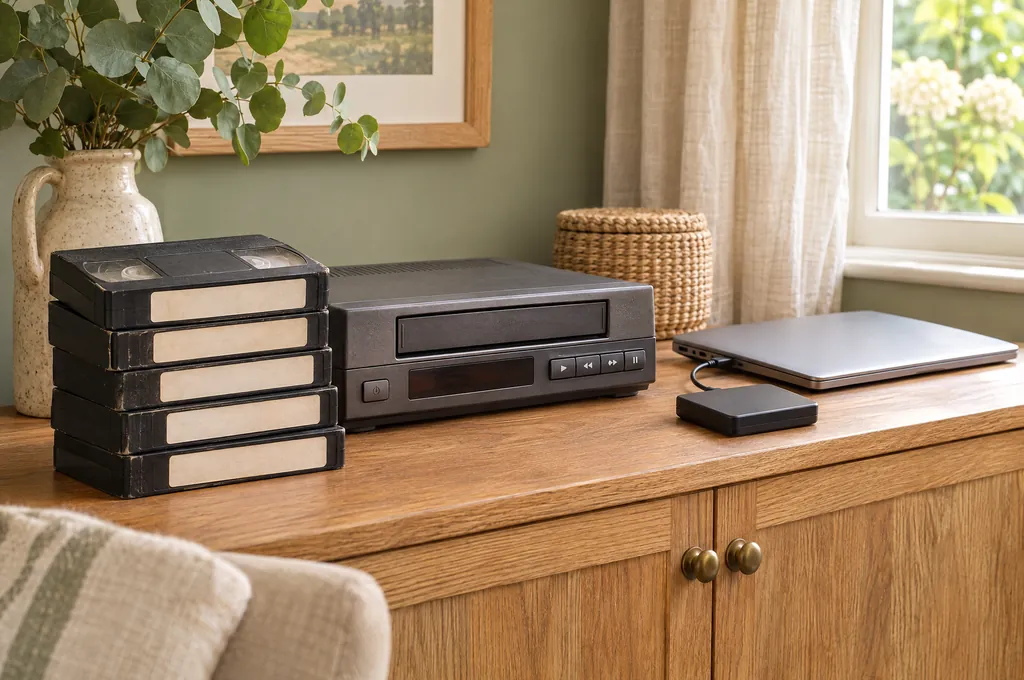
Quick answer: Check what is on them first, and digitise any home videos before you let the tapes go, because once a tape is thrown away the recording is lost for good. UK digitising services start from around £13 a tape. Shop-bought films can usually go. VHS tapes are made of mixed materials, so most councils will not take them in kerbside recycling: take them to a household waste recycling centre or put them in general waste, and recycle old video players as electrical waste.
In this article
Many homes still have a box of VHS tapes somewhere: films recorded off the television, workout videos, and, most importantly, home videos of weddings, birthdays, holidays and family members who are no longer here. With fewer and fewer people owning a working video player, those recordings are at real risk. This guide explains what to do with old VHS tapes, how to save the ones that matter and how to dispose of the rest.
Step one: work out what you have
Sort the tapes into three piles:
- Home videos. Anything recorded on a camcorder, including family events, holidays and children growing up.
- Recordings off the television. Usually safe to let go, unless they include something personal, such as a family member appearing on the news.
- Shop-bought films and videos. Almost always safe to let go, as most are available to stream or buy again.
Be careful with labels. Tapes are often mislabelled or not labelled at all, and digitising companies regularly find weddings, christenings or a grandparent's voice on a tape marked as a football match. If you are not sure what is on a tape, treat it as a home video until you know otherwise.
Why you should digitise home videos soon
Magnetic tape slowly deteriorates. Over the years, colours fade, the picture becomes noisy, and tapes can develop mould if they have been stored somewhere damp, such as a loft or garage. Working VHS players are also becoming hard to find and repair. The longer you wait, the harder it becomes to rescue the recordings.
How to digitise VHS tapes
Use a professional service
This is the easiest and usually the best option. Many UK companies convert VHS, VHS-C, Hi8 and other formats to digital files, which they send to you by download, on a USB stick or on a hard drive. One UK service, Tapes To Digital, charges from £13 a tape, does not charge for tapes that turn out to be blank, and offers mould cleaning and tape repair from £13 a tape. Prices vary, so compare a few services, check how they look after your originals, and ask whether they return the tapes.
Do it yourself
If you still have a working VHS player, you can buy a USB video capture device that connects it to a computer. It takes time, because each tape has to play in real time, and quality depends on the condition of your player. For a handful of tapes it can work well. For a large collection, a professional service is often more practical.
Look after the digital files
Once your videos are digital, keep at least two copies in different places, such as an external hard drive and a cloud storage account. Name the files clearly, for example 1994-summer-holiday-arran, and share copies with family.
How to dispose of VHS tapes in the UK
VHS tapes are made from a mix of plastic, magnetic tape and small metal parts, which makes them hard to recycle. Most councils do not accept them in household recycling bins. Your options are:
- Household waste recycling centres. Most will accept VHS tapes, usually with general waste. All four Glasgow City Council recycling centres accept general household waste.
- General waste bin. Small numbers of tapes can go in your general waste.
- Specialist recycling schemes. A few companies and digitising services offer tape recycling, sometimes for a fee.
- Charity shops. Some accept shop-bought films, but many no longer do, so ask first.
Do not put home videos in the bin without checking what is on them, and remember that recordings can show people and places you may not want strangers to see.
What to do with an old video player
Video recorders, camcorders and DVD players count as electrical waste and should not go in your household bin. Take them to an electrical recycling point at a household waste recycling centre or a retailer take-back scheme. A working VHS player may be worth keeping until you have finished digitising, or giving to someone who is digitising their own tapes.
Romaine's tip: Once your home videos are digitised, hold a family film night and watch a few together. It is a lovely reason to finish the job, and it often turns up names, places and stories that are worth writing down while people still remember them.
More help with family memories
VHS tapes usually sit alongside other keepsakes. Our guides to old photo albums and old letters and cards use the same approach. If you are clearing a whole house, see what clearance companies will and will not take.
Frequently asked questions
Can VHS tapes go in the recycling bin?
Usually not. They are made of mixed materials, so most councils ask you to put them in general waste or take them to a recycling centre.
How much does it cost to digitise VHS tapes in the UK?
Prices vary between services. One UK service charges from £13 per tape, so a box of twenty home videos might cost a few hundred pounds. Always get a quote first.
Do VHS tapes deteriorate?
Yes. Magnetic tape degrades over time, especially in damp or warm conditions, so it is best to digitise important recordings as soon as you can.
What should I do with an old VHS player?
Keep it if you plan to digitise tapes yourself. Otherwise recycle it as electrical waste at a recycling centre or retailer take-back point.